
After the wild popularity of my article and illustrations about the ampersand “and symbol,” I began to develop quite the curiosity about other symbols that we use on a daily basis. It wasn’t long before the “at sign” – written: @ – caught my attention. What is the graceful “at symbol’s” official name and history, and how has its usage changed over time? Read on to learn.
As background, I am an artist and English teacher named Ms. Marshall, and I hand-draw every single illustration on this site with love – including the recent Pi symbol celebration! On to today’s lesson…


What is @ Called?
Though most people call @ “the at symbol” or “at sign” in English, its geeky official name is the “commercial at” (or sometimes the “ampersat,” as a play on “ampersand”) — much less soothing than the name of the “Om Symbol.” However other languages have more fun with the title of @.
In fact, the sign is called a “monkey tail” in Dutch, a “strudel” in Israel, and a “snail” in Italian — all names that play on the symbol’s looks. This leads us to a discussion of how to write it, and what symbol art @ resembles…
How To Write the “At Sign”
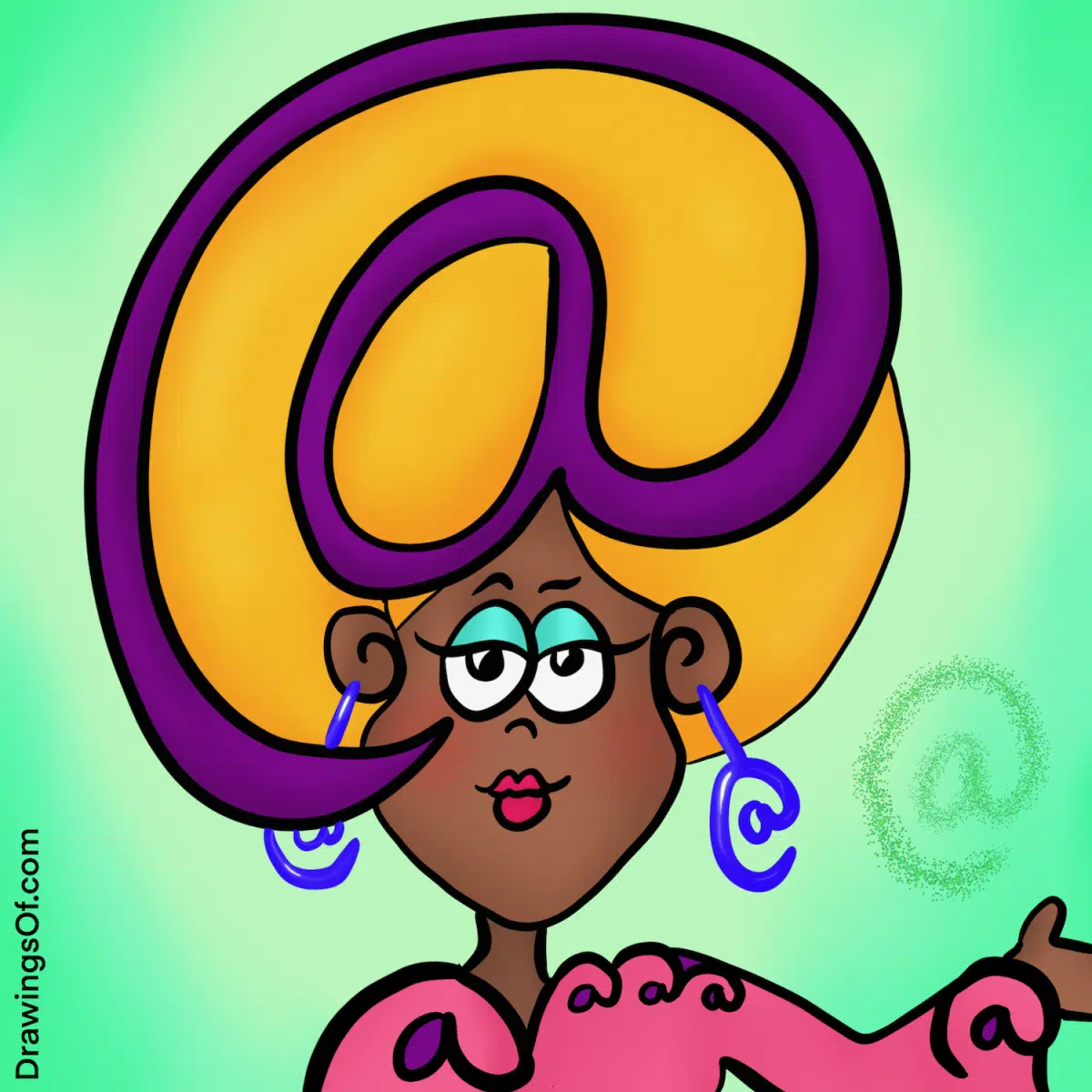
The “at sign” is beautiful, whimsical, and fun! It’s written by sketching a lowercase “a” (in the style without the top line), then pulling its “tail” all the way around into a circle, thus forming: @. Some may say this symbol looks like a cute snail drawing, but the more I gaze upon it, the more I see something else… a fancy hat or hairdo! Here’s my illustration to demonstrate.

Modern Uses of @
Why is @ so useful nowadays? The “at sign” is used all the time in the 21st century modern electronic world to indicate “at” or “to” someone or something. It’s used both in email addresses (for example: Name@Email.com), and to tag someone in social media, such as @PersonTagged. But what are this symbol’s origins?
History of the “At Symbol”
The history of the “at sign” traces back hundreds of years, and begins a bit hazily. What we do know is that in the mid-1500s, Spanish and Portuguese traders used it in commerce transactions for a unit of volume, calling it “arroba” — a term that’s still used in that region for it today.
The symbol’s popularity skyrocketed after it email was launched in 1971 and the programmer, Ray Tomlinson, settled upon @ to designate the linking character between the user’s name and their email host. He picked the “at symbol” because it was so rarely used at the time, so would cause less confusion; it was also a logical choice, as it visually does suggest the “at” connotation.
The “At Sign,” in Sum
I hope this exploration of the graceful “at symbol” — along with its name, how to draw it, and its history and uses — has been useful and interesting. Which signs would you like me to illustrate and investigate next, beyond the treble clef symbol? Do share!
Want more? Gaze upon the lovely Reiki symbols used in Usui energy balancing work.

The author and artist, Lillie Marshall, is a National Board Certified Teacher of English who has been a public school educator since 2003, and an experienced Reiki practitioner since 2018. All art on this site is original and hand-drawn by Lillie. She launched DrawingsOf.com Educational Cartoons in 2020, building upon the success of her other sites, AroundTheWorldL.com (established 2009), TeachingTraveling.com (founded 2010), and ReikiColors.com. Subscribe to Lillie’s monthly newsletter, and follow @WorldLillie on social media to stay connected!