As I've been working on my growing list of hard words to spell in the English language, a new category began to emerge: commonly misspelled words. These are the words that are misspelled so often, that we have grown used to the "fake words" and believe (not "beleive") they're correct. As an ELA teacher for the past 18 years, I've seen my share of these!
Still confused about what I mean? Here are some examples: When trying to spell attendance, we often write: "attendence" with an "e" -- not realizing that it then becomes a nonexistent word. Another super common example is "Everytime." It seems like that would be a correct spelling because "everything" and "everywhere" are real words -- but it's simply not!
Commonly misspelled words!
Now, I'm not talking here about commonly confused words like the old favorites, "loose vs. lose" or the sandy and sweet pair, "dessert or desert" -- all of which are correct, depending on the surrounding meaning and context of the sentence. No -- for this list of commonly misspelled words, I'm rounding up the seemingly correct spellings that are simply WRONG.
Together, we can learn some fun tricks to avoid making the mistake of using incorrect spellings like "freind!" Let's see the list, replete with my hand-drawn illustrations. Click through any of the offerings in the round-up below for each full spelling lesson.
Commonly Misspelled Words
Here's a growing list of commonly misspelled words that people spell incorrectly so often that we don't even realize they're fake words that are just wrong! See tricks on how to remember the right spelling and avoid these writing mistakes.
Spelling "definitely" is one of the hardest words out there, since it has so many ambiguously-sounding vowels. The silly sentence, "Daniel Eats Fish IN IT Every Leap Year" can help remember their order -- and not write the incorrect "defenitely."
There are SO MANY incorrect ways to spell dilemma, but "dilema" is a common one. To remember the letter order, picture the sentence, "Do It Like EMMA!"
It's counter-intuitive, but the spelling of the word that means fire-like is actually "fiery," not "firey!" Use the pronunciation to help you remember -- or the fact that it sends people into a fiery rage that it's so illogical.
It doesn't feel logical, but the number 40 is spelled "forty" (with no "u"), not "fourty" -- even though 4 is written "four" and 14 is spelled "fourteen" -- both with a "u!"
The bright purplish pink called fuchsia is incredibly hard to spell, because it seems like it should be spelled "fushia" given how it's pronounced... but it's not!
Though the pronunciation of the word that means "protector" or "to protect" sounds more like "gaurd," the correct spelling of the word is "guard," with a "U-A."
To remember to spell "grateful" correctly -- and not incorrectly as "greatful"), visualize a person holding up a metal grate that they're thankful for!
The word "incase" doesn't exist! You either mean to spell "in case" (with a space in between the two words), or, less likely, "encase," meaning to enclose.
To recall that there is a letter "T" hidden in the middle of the word "listen" (and avoid spelling it "lisen"), remember that you listen with TEN fingers cupped around your ears.
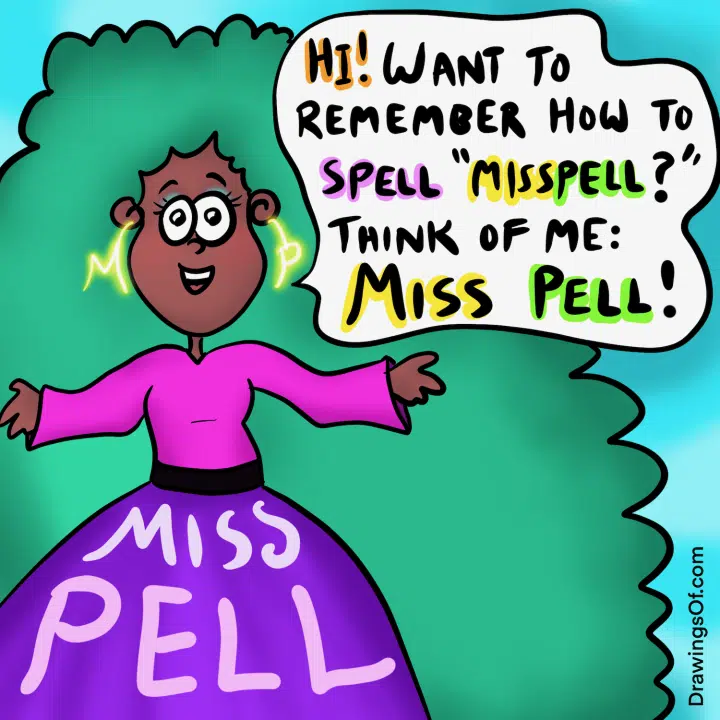
Ironically, the word misspelled is often spelled wrong, as "mispelled." To remember the double "S," picture. a woman named Miss Pell and you wont misspell the word again.
The word "noone" doesn't exist! Instead, make sure there is a space between the two words -- "no one" -- in other words, leave a gap where no one is sitting!
There are so many incorrect spellings of the word "rhythm," but "rythm" is the most common. Remember the correct letter order by the phrase: "Radio Has Your Two Hips Moving."
To remember the correct spelling of separate (and not accidentally write "seperate") remember that there's a RAT crawling around in the middle of the word!
The word that means "nervous and prone to running away" is often misspelled "skiddish," but the correct way to write it is "skittish" -- with a double "t."
The misspelling "weither" is often used when people are actually trying to write "whether," "weather," or "either" -- among other options. Learn more about them here.
If you're writing about the magical woman who usually wears a pointy hat, write "witch." For the pronoun asking you to choose between two things, or specifying a previously-mentioned thing, write "which." The spelling "whitch" doesn't exist!
So, which of these commonly misspelled words are you most lured into the trap of using? For me -- quite ironically, I'll admit -- one of the most seductive of this set is writing "mispelled" using just one "s."
I am also supremely guilty of using the misspelling, "greatful" when I mean "grateful." It's just so seductive to use the "great" opening to the word, since when you're grateful, you think something is great! But no -- that's incorrect. Think of a metal grate instead.
What other frequently used "fake words" and misspellings should I add to this list -- such as "incase" or "fushia," or the ever-deceptive "flys?" Do share your ideas and requests in the comments section below!
Want more? Check out my growing list of common homophones!If you want a complex misspelling situation, read my post about "lier or liar" -- they're both real words, but one is only correct 0.000001% of the time!
The author and artist, Lillie Marshall, is a National Board Certified Teacher of English who has been a public school educator since 2003, and an experienced Reiki practitioner since 2018. All art on this site is original and hand-drawn by Lillie. She launched DrawingsOf.com Educational Cartoons in 2020, building upon the success of her other sites, AroundTheWorldL.com (established 2009), TeachingTraveling.com (founded 2010), and ReikiColors.com. Subscribe to Lillie's monthly newsletter, and follow @WorldLillie on social media to stay connected!